


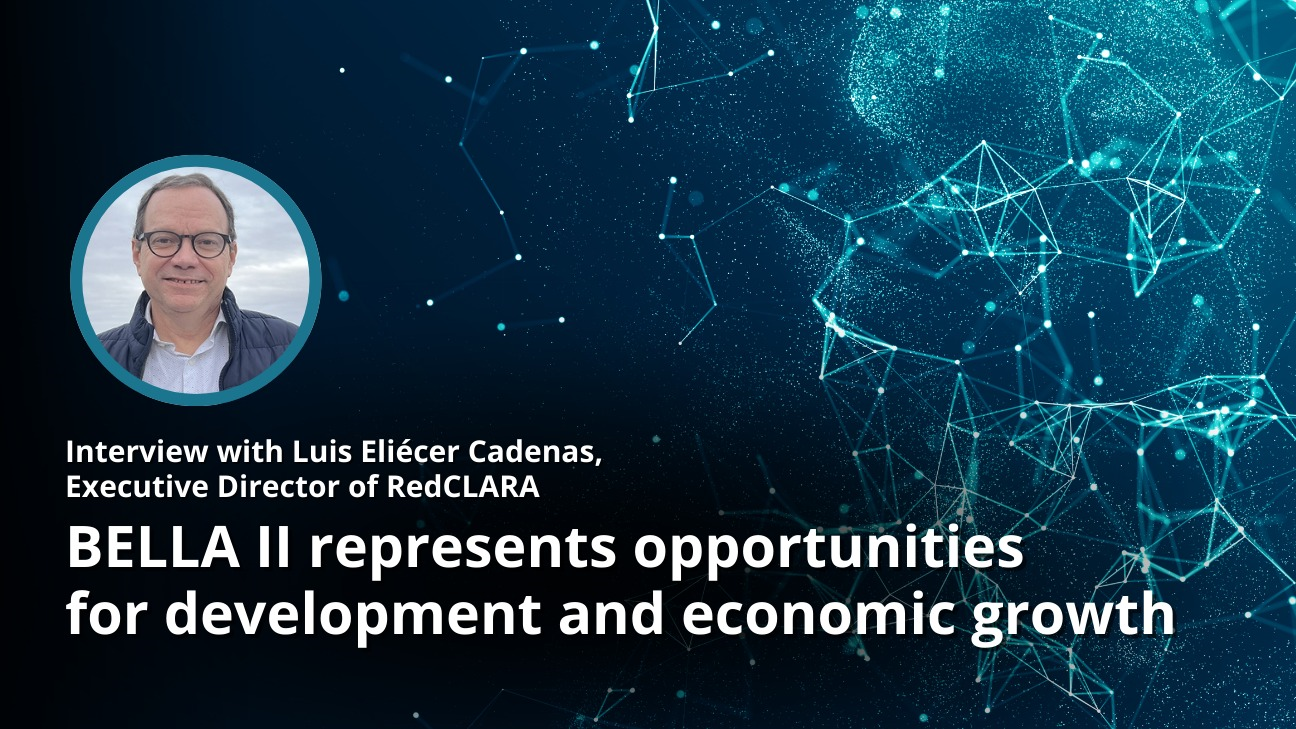
As it enters its final year of implementation, BELLA II has established itself as a vital tool for fostering digital collaboration between Europe and Latin America and the Caribbean.
Led by RedCLARA and co-funded by the European Union, the programme fosters collaboration within academic, scientific, and innovation ecosystems. This strengthens knowledge as a public good and contributes to inclusive and sustainable development.
In this interview, Luis Eliécer Cadenas, RedCLARA Executive Director, reflects on the origins of the project, its main achievements, the role of RedCLARA, and the impact that this cooperation is having, and will continue to have, on universities, research centres, governments, and communities.
What is BELLA II, and what are its main objectives?
BELLA II is a project implemented by RedCLARA and co-funded by the European Commission, which aims to strengthen digital cooperation. One of its core objectives is to expand advanced connectivity in five countries: Peru, Costa Rica, Guatemala, Honduras, and El Salvador, thereby helping to close gaps and achieve regional connectivity.
A second component consists of developing experimentation spaces for digital transformation technologies, which facilitate access to advanced technologies for universities, research centres, and businesses, supporting the development of new solutions, knowledge generation, innovation, and the strengthening of research, among other areas.
The third objective is to facilitate stronger links between scientific and academic infrastructures in Europe and Latin America, and to promote the strategic use of connectivity services that enable deeper and more sustained collaboration between the two regions. In this sense, it also aims to better use the submarine cable we have that directly connects Europe and Latin America.
How did BELLA II emerge, and what results did the previous phase deliver?
BELLA II follows on from the initial phase of the BELLA project, which we now refer to as BELLA I in order to distinguish it. That project had two sub-components — BELLA-S and BELLA-T — and concluded in 2022.
BELLA-S focused on establishing, for the first time, a direct connection between Europe and Latin America through a new submarine cable. Stretching over 7,000 kilometres, the cable now links Sines, Portugal, with Fortaleza, Brazil. This infrastructure was designed specifically to meet the needs of the academic, research, and education sectors, offering high standards of capacity, speed, and security, as well as other features that enable multiple possibilities for cooperation.
BELLA-T, developed in a complementary and simultaneous manner, expanded connectivity to several countries in the region by leveraging that direct link — including Chile, Argentina (which is not part of the project, but through which the connectivity passes), Brazil, Panama, and Ecuador. These were the countries initially affected.
BELLA II is the continuation of that process, with the aim of reaching more countries and providing additional services and infrastructure capacities.
What makes BELLA II such a strategically important initiative for both the region and the EU-Latin America and the Caribbean relations?
First and foremost, because it helps to build and strengthen the regional digital ecosystem that supports research, education, and innovation activities in the region. By connecting Latin American universities and research centres with major capabilities to their European counterparts, broad spaces for cooperation are created — and that cooperation, in turn, represents opportunities for development, economic growth, the creation of new applications, and the further expansion of the areas in which Europe and Latin America work together.
Particularly in Latin America, given the differences — let us say — in the development of national education and innovation systems, it helps to “level the playing field” so that all actors, institutions, and organisations can have more or less equitable access to resources that are scarce yet essential to their work. For example, high-performance computing, artificial intelligence and cybersecurity: within a framework of cooperation such as that enabled by RedCLARA, these generate synergies that strengthen such projects far more.
What role does RedCLARA play in implementing BELLA II, and how does it collaborate with European partners?
RedCLARA is the lead implementer of BELLA II — the organisation driving it forward. Its engagement with European actors is formally framed within the EU–LAC Digital Alliance, announced at the 2023 EU–CELAC Summit. In this context, RedCLARA is an international technical cooperation organisation that has enabled a large number of investment projects supported and promoted by the European Commission itself. We are talking about around 12 projects, of which BELLA II is the most recent.
What are BELLA II's main achievements so far?
We have implemented several important services derived from the project. One of the most significant is the launch of three experimentation spaces, or testbeds. One focuses on blockchain technology and has been developed in partnership with LNet, enabling universities and research centres to experiment with and develop blockchain-based solutions. LNet is an organisation founded or created jointly by RedCLARA, LACNIC, and BidLAB.
We have another testbed dedicated to bioinformatics, which uses artificial intelligence and intelligent agents to help discover and develop knowledge in bioinformatics or cellular biology. The third space is high-performance computing (HPC), which leverages existing infrastructure in Latin America to provide the region with high-performance computing hours for projects of various kinds. These three are already in place. We are advancing other services that have reached a certain level of development but are not yet delivering services, including cybersecurity and artificial intelligence in a broader sense,
We have also progressed in negotiating and identifying options and are in a process of competitive dialogues with potential telecommunications providers in the region to deliver connectivity for the countries included in the project, through procurement or co-investment models that, I believe, could greatly help evolve how National Research and Education Networks (NRENs) acquire their infrastructures.
These are the main achievements, along with the momentum we have been building for cooperation among countries within the framework of the Digital Alliance and its links with other projects, such as Copernicus, as well as other initiatives within the broader context of this cooperation.
What stage is the project at now, and what are its future prospects?
BELLA II is currently in its final phase of implementation, launched in January 2023 and scheduled to conclude in December 2026. With administrative closure processes, the submission of final reports, and the closure of certain initiatives, it should be completed in full by mid-2027.
During this final period, our main expectations follow two tracks. First, a significant increase in cooperation and work with the new countries that will complete their connectivity during this period, expanding capabilities, and using infrastructure and resources.
Second, a forward-looking perspective includes the possible expansion of the project into a phase three, in which additional countries would be incorporated. Our ambition is to connect all of Latin America and the Caribbean to this digital ecosystem. We therefore expect to continue working on successive associated projects.
What impact does BELLA II have on people and communities beyond technology?
The impact is twofold. First, there is clearly a direct impact on students and researchers, because BELLA II facilitates the use of technologies and infrastructures that strengthen their academic and scientific work — and that would otherwise be difficult for many of them to access. Second, there is an indirect impact through the strengthening of national innovation systems and the contribution of scientific and educational cooperation to economic and social development. These are the two main impacts the project can have.
What role should different stakeholders play to maximise the project’s impact?
Their active participation in the project model is essential. We have spoken about the possibility of working within the framework of public, motivated and, as they now call them, “personal” partnerships — the term 4P is now used — to strengthen cooperation as much as possible around these issues, which affect society as a whole.
To the extent that governments can contribute resources and support the development of other initiatives that also build greater capabilities within national systems in each country, as well as regionally, the impact will grow. The participation of all sectors of society is fundamental, so that the project can be fully leveraged, developed and used in the way we have planned.
What final message would you like to share with stakeholders across the region?
To make use of this infrastructure, developed collaboratively over 23–24 years through RedCLARA’s work in these areas. It is a public infrastructure with the value of a public good, regardless of the fact that RedCLARA is a private non-governmental organisation. What has truly been built across the region is a public good that can be of great use to all social actors in each Latin American country.
Ultimately, the main message is to make the most of what we are building in pursuit of development objectives and economic and social growth in the countries of the region.